Why My Numbers Are Floors, Not Totals
A trace total is the minimum the record shows, not necessarily all that moved. Pagination, coverage windows, and source limits turn a clean figure into a claim that needs boundaries.
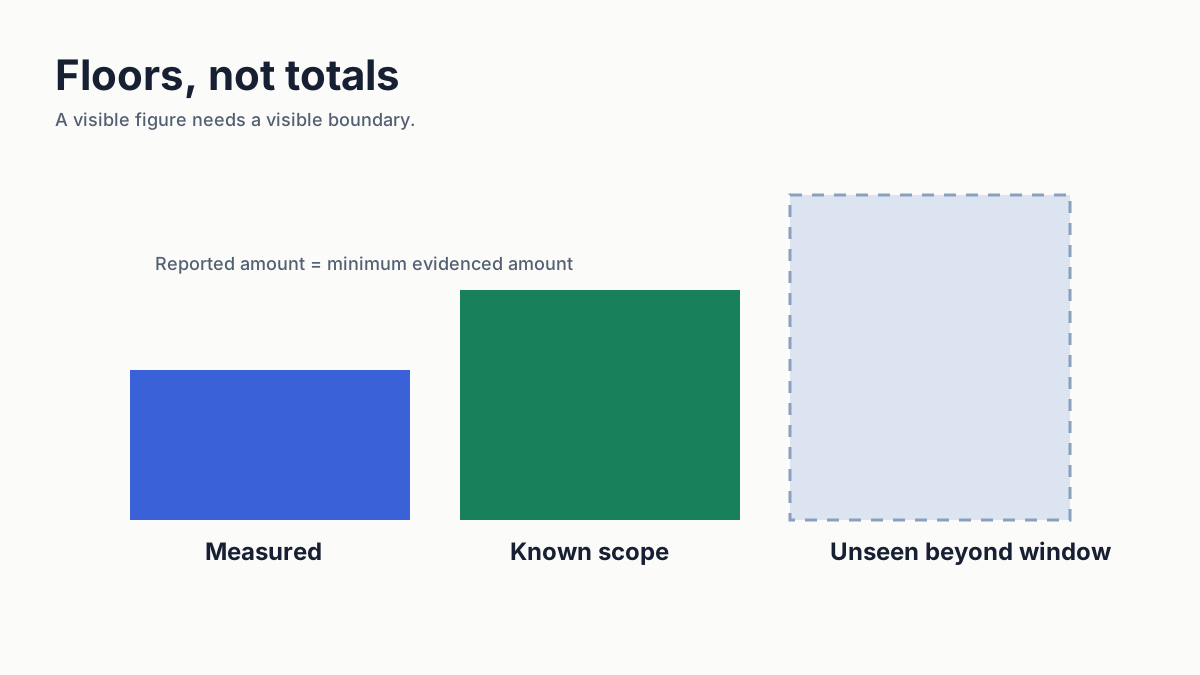
The cleanest number in a tracing report is often the easiest one to overstate.
It is tempting to write that a certain amount moved. Sometimes that is exactly what the record proves. Often, the more honest sentence is narrower: this is the amount visible in the records and window reviewed.
That distinction matters because digital records are not always complete merely because they are public. Interfaces paginate. Services have coverage windows. Indexers may return an incomplete history. A result set can end before the underlying activity does.
The figure may still be useful. It is simply a floor, not automatically a total.
A visible number has a boundary
A reported amount should answer four questions:
- What records produced it?
- What time or block window did they cover?
- What is included in the figure?
- What known gap prevents it from being called complete?
These questions are not decoration. They make the number auditable. A reader can understand what was measured, what was not, and whether a later source could change the result.
The alternative is a number that looks decisive but cannot be reproduced or challenged intelligently. That kind of certainty does not survive serious review.
Why a floor can be more valuable than a larger claim
People sometimes think a cautious number weakens a report. It can do the opposite.
A floor makes a limited claim that the evidence can support. It tells a client, lawyer, or compliance team that at least this amount is present in the declared record. It leaves room for new data without forcing a correction framed as a contradiction.
An inflated total creates the reverse problem. If later records reveal an excluded page, a missing window, or an unseen route, the entire report can appear unreliable even where its underlying work was sound.
India's Crypto Tax Visibility Gap uses the same distinction at a policy scale. A measured share can be a floor for a particular population without being a national census. The data can be useful precisely because its limit is named.
The gap belongs beside the number
Do not hide the limitation in a footnote after the headline. State it where the number appears.
For example: “The figure reflects activity visible in the reviewed public-record window. It is not presented as a complete total outside that window.” That sentence does not weaken the finding. It defines it.
The reader now knows what the number can support. If an institution needs a complete account, the report can identify the next source or authority required rather than pretending that more public searching will turn a bounded record into a complete one.
A number is evidence, not a performance
The pressure to produce a neat total is understandable. Numbers travel well in headlines, presentations, and client calls. But a forensic figure should not be selected for how impressive it sounds. It should be selected for what can be defended.
That is the connection to Evidence Tiers. A quantity has its own evidence tier. A directly measured amount is different from a model, a range, a floor, or a projection. Calling each one by the right name is part of the work.