The Lead Is Not the Case
I keep unverified observations separate from formal case work. An interesting address is not a case until evidence justifies a deliberate decision to promote it for further investigation.
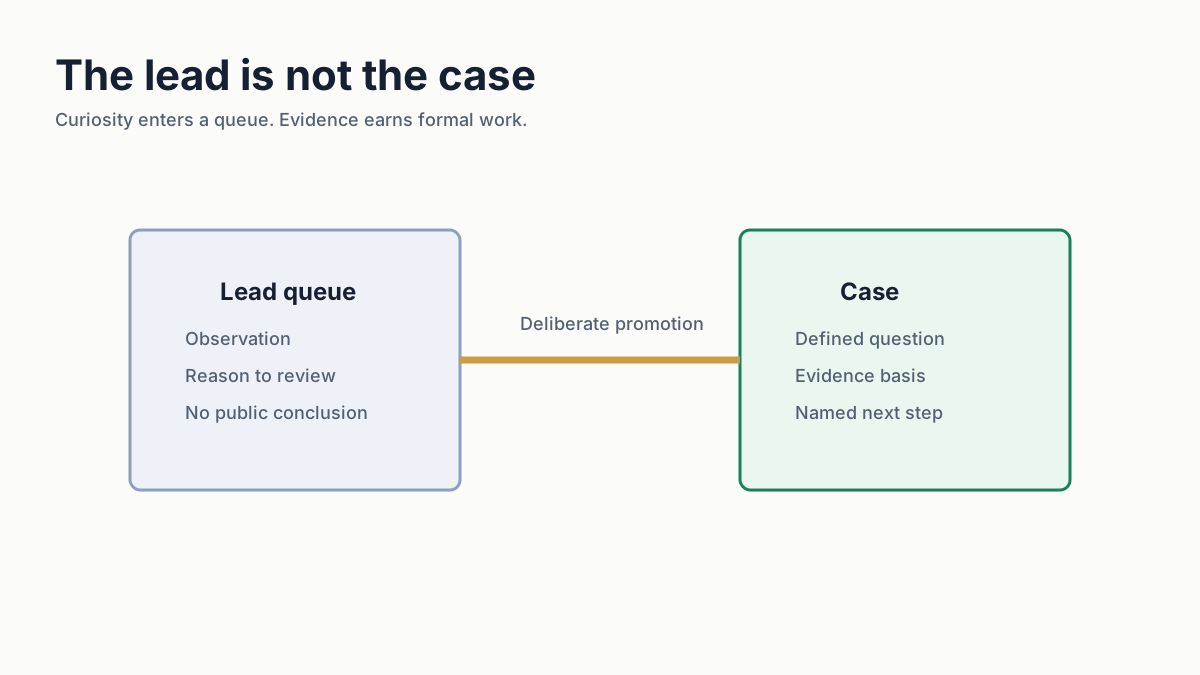
An interesting address is not automatically a case.
That sounds obvious, but it is an important discipline in any investigation practice. A record can be unusual, relevant, or worth revisiting without being sufficiently verified to deserve a case number, a client narrative, or a public conclusion.
When every interesting observation becomes a case, the caseload starts to lie. It fills with material that has not earned its status, and attention shifts from evidence to volume.
A lead is a reason to look further
A lead is an unverified observation with a reason for further attention. It may be a pattern, an incoming report, a public record, or a connection that needs more context. It is not a verdict, and it is not a public claim.
The distinction gives the work room to be curious without becoming careless. A lead can be checked, closed, held for later, or promoted. Most should not become a formal matter. That is not wasted work. It is the system refusing to turn every signal into a story.
Promotion has to be deliberate
A case begins when there is a defined question, enough initial evidence to justify formal work, and a person or process responsible for the next step. It should not be created because an address is visually connected to something else, because a transaction looks unusual, or because a dashboard makes the pattern feel important.
The precise promotion criteria belong inside the practice, not in a public playbook. The public principle is simpler: promotion should be deliberate, documented, and based on more than curiosity.
That protects the reader as well as the practice. A formal case file signals that the material has reached a different standard of care. If every lead is labelled a case, the label stops communicating anything useful.
Quiet closure is a healthy outcome
People like open files because they create the impression of activity. Good investigative discipline is often quieter. A lead may close because the public evidence does not support further work, because a credible ordinary explanation emerged, or because the question requires records that are not available.
Closing a lead is not admitting failure. It is applying the same restraint described in Falsify First. The work has tested an observation and decided that the available evidence does not yet justify more.
Avoiding caseload theatre
There is a temptation to describe every promising observation as an active investigation. It sounds productive. It is also misleading.
A serious practice should be able to say what is a lead, what is a formal case, what has closed, and what remains unresolved. Those categories are not marketing language. They are part of evidence hygiene.
The same principle applies to public writing. A lead should not become a blog post. A case analysis should be based on a sufficiently developed, disclosure-safe record. A Case File a Reader Can Check explains why public work should give readers a way to inspect the boundary, rather than merely accept the conclusion.
The discipline serves the next decision
The purpose of a lead queue is not to collect interesting addresses. It is to make better decisions about where evidence and attention should go next.
That is why the lead is not the case. One is an observation waiting to earn more attention. The other is a defined matter that has already earned it.