I Name the Crime Last, Not First
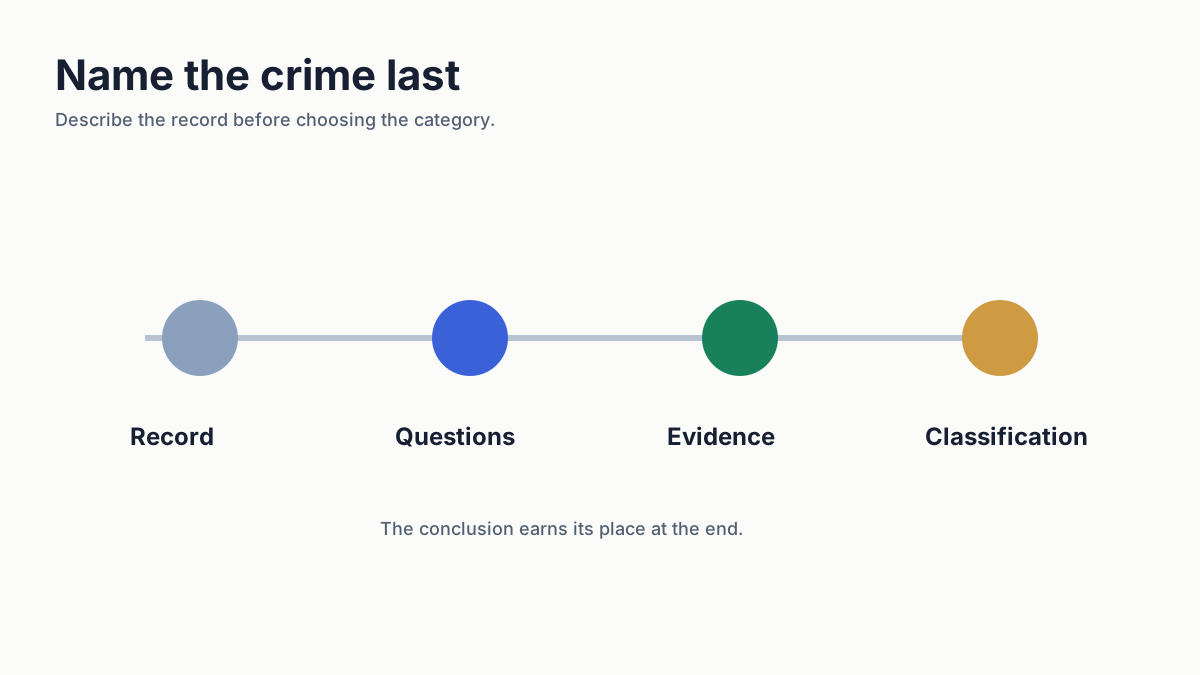
The instinct is to label a matter first and gather data that fits. I do the opposite: the record arrives first, and any classification has to earn itself.
Cases often arrive with a name already attached to them. A victim, lawyer, colleague, or headline has described what happened. The label is understandable. It gives a frightening experience a shape.
It is also dangerous if it becomes the first instruction for the investigation.
Categories carry assumptions. Once a matter is called one thing, the mind begins looking for the evidence that belongs to that thing. Contradictory facts look peripheral. Ordinary facts become suspicious. The conclusion starts organising the inquiry before the record has had a chance to speak.
Description comes before classification
The early record should be described in plain terms. What moved? When did it move? Which records are public? Which questions are unanswered? What is directly observed, and what is only being suggested by the story so far?
That is not avoiding the problem. It is preserving the possibility of seeing it correctly.
A high-volume address is a fact about volume. A series of transfers is a fact about movement. Neither is a crime category by itself. The legal or investigative classification may eventually be justified, but it has to be earned through evidence that supports that specific conclusion.
The cost of pre-classification
Pre-classification changes the questions people ask. It can narrow source collection, change which alternative explanations are considered, and make a report sound more certain than its factual base permits.
The effect is especially pronounced in technical work. A chart or a graph can look conclusive even when it simply shows that a set of records are connected in some visible way. Visual clarity is not the same as evidentiary clarity.
Falsify First is the discipline that helps resist this. A label that cannot survive a credible alternative explanation is not a conclusion. It is an early theory.
Holding more than one explanation open
This does not require pretending that every explanation is equally likely. It requires allowing the available evidence to change the balance without forcing it into a predetermined category.
Some explanations will become less plausible as the record develops. Some will need off-chain records to resolve. Some will remain uncertain. That is normal. The investigator’s job is not to make uncertainty disappear through vocabulary.
The most valuable report may be the one that says: these facts are established; these interpretations remain possible; this is the next record needed; classification is not yet settled.
The label belongs at the end
When evidence is sufficient, a classification can be made carefully and tied to its basis. When it is not, the honest classification is still “unresolved.”
That restraint protects people, institutions, and the work itself. It is also what keeps an investigation open to correction when a new record arrives.
The public chain is a record. It is not a verdict. Evidence Tiers gives the language for saying that plainly.