Guardian Agents: Autonomy Without Oversight Is Just Faster Risk
Only a fraction of firms have shipped AI agents, yet most plan to. Hallucination rates and breach data say the same thing: autonomy without a second loop is not scale. It is exposure.
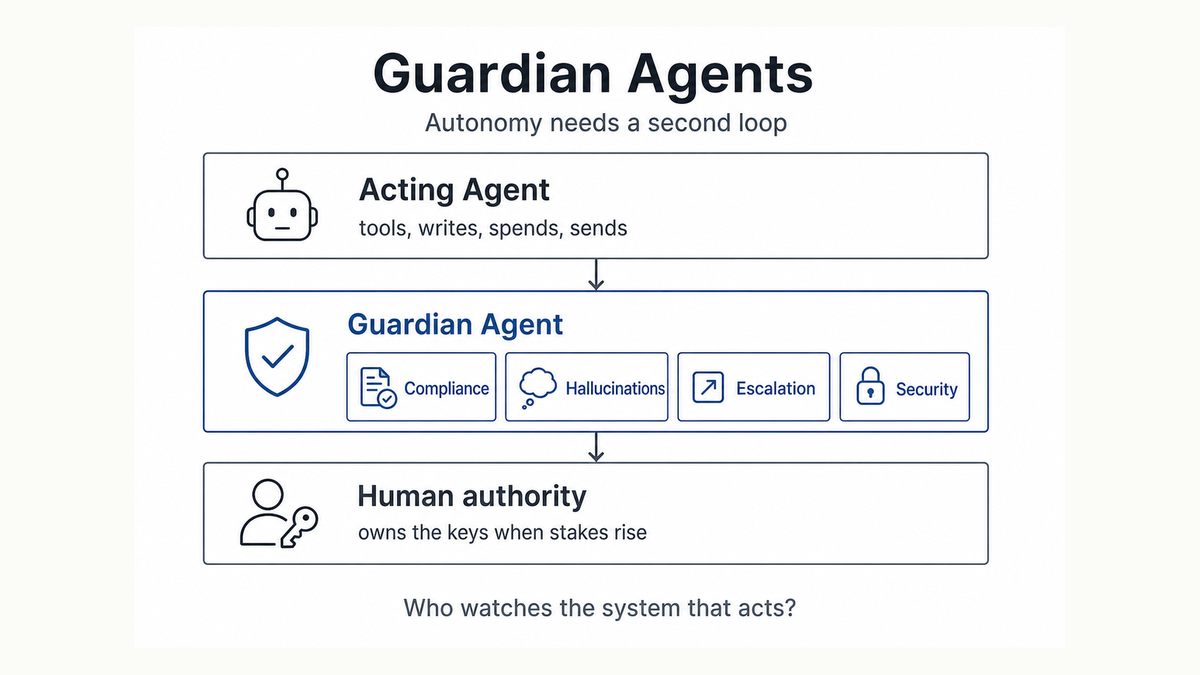
The more autonomous an AI agent becomes, the more important supervision becomes.
That sentence should make you uncomfortable if you are currently shipping “fully autonomous” demos into anything that can spend money, change records, or talk to customers. Most of the agent hype is selling the opposite story: remove the human, keep the speed, call it scale.
In a production environment, autonomy without governance is not scale. It is high-speed risk with a nicer name.
If you give an agent the power to act, you must also give another system the power to monitor it. I call these Guardian Agents. They are the missing layer in the agent hype cycle, and the numbers say the market is building the acting layer first. For the buying test of whether something is an agent at all, see what makes an AI system an agent and agent washing versus real architecture.
The adoption gap is the point
Gartner’s 2026 Hype Cycle for Agentic AI places agentic AI at the Peak of Inflated Expectations. Only 17% of organizations have deployed AI agents so far. More than 60% expect to do so within two years, which Gartner calls the most aggressive adoption intent curve among the emerging technologies in that survey.
Read that again. Intent is running far ahead of shipped systems. That is not a reason to move faster. It is a reason to ask what those systems will do when they fail, and who will notice in time.
Gartner’s own framing is blunt: most deployments remain narrowly scoped, and fully autonomous agents are not ready for the majority of enterprise use cases. Computerworld’s reporting on Gartner makes the same operational point: even as agent counts grow, humans stay in the loop for security and governance. Semi-autonomous systems with oversight are what enterprises can actually run.
So if your pitch deck still says “no human required,” you are not ahead of the market. You are arguing with the part of the market that has already been burned by demos that could not survive audit.
Hallucinations do not get polite in production
A Guardian Agent exists because models do not announce when they are inventing.
Stanford RegLab and HAI put “hallucination-free” legal research tools on a preregistered benchmark. Even purpose-built RAG systems from major legal vendors still failed often enough to matter: Lexis+ AI and Ask Practical Law AI produced incorrect information in more than 17% of queries; Westlaw’s AI-Assisted Research hallucinated in more than 34% of cases (Stanford HAI write-up; paper).
That is not a chatbot novelty problem. That is a domain tool sold into high-stakes work, still wrong roughly one time in six, or one time in three, depending on the product.
Now ask the question teams skip: if a legal research assistant can miss that often with curated corpora, what happens when your agent can also click, file, transfer, or approve?
A fluent wrong answer that stays on screen is a research problem. A fluent wrong answer that triggers a tool call is an incident.
The oversight gap is already measurable
IBM’s 2025 Cost of a Data Breach Report studied AI security for the first time in that series. Among organizations that reported a breach involving AI models or applications, 97% lacked proper AI access controls. 63% of breached organizations either had no AI governance policy or were still developing one. High levels of shadow AI added about USD 670,000 to average breach cost versus low or no shadow AI.
The subtitle of that story is the AI oversight gap. You do not need science fiction. You need the boring fact that organizations are giving systems power faster than they invent the controls around them.
An acting agent without a guardian is the same pattern with more autonomy: capability first, inventory later, accountability never.
What the control layer has to do
A real agentic system needs a control layer that handles four jobs. Not as slogans in a slide. As runtime behavior.
Compliance. Keep the acting agent inside legal and company boundaries. A Guardian Agent treats those boundaries as enforceable constraints, not as prompt text the model can ignore when the task gets interesting.
Hallucinations. Catch errors before they trigger a real-world action. The guardian’s question is not “does this sound good.” It is: how would we know this was false before anything irreversible happens.
Escalation. Know when a task is too novel, too consequential, or too ambiguous, and route it to a human. Escalation is not failure. It is the difference between a system you can run and a system that eventually embarrasses you in public.
Security. Prevent the agent from accessing data and tools it does not need. Least privilege is not optional once the agent can call APIs, open tickets, or move money. Gate capability the way you would gate a junior hire with production credentials.
Without this layer, “agentic autonomy” is automation with better branding.
McKinsey’s agentic AI work makes a related architectural claim: agents introduce risks traditional gen-AI setups were not built for, including uncontrolled autonomy, weak observability, and sprawl. Their answer is governed autonomy and an operating model that treats control as part of the system, not a policy PDF next to it.
Scale is a trust problem
Scaling AI is not about how many tasks you can hand off to a bot. It is about how many tasks you can trust a bot to complete without breaking the system.
That trust does not come from a larger model. It comes from a second loop that watches the first: what was attempted, what was allowed, what was blocked, and what required a person.
Teams that only build agents to act will ship impressive demos and then spend the next year cleaning up after them. Teams that build systems to govern those agents will ship quieter products that survive contact with compliance, customers, and reality.
If your roadmap has twenty agent features and zero guardian features, you are not under-resourced on intelligence. You are under-resourced on adult supervision.
The question worth asking
Are you building agents to act, or are you building systems to govern them?
If the honest answer is only the first, you do not have an agentic system yet. You have a fast intern with no manager, and you have given it the keys.
The uncomfortable part is this: the market is already telling you that “fully autonomous” is not the production target. The research is already telling you that domain tools still invent. The breach data is already telling you that access control and governance are lagging adoption.
So the remaining question is not whether Guardian Agents are a nice idea. It is whether you will build them before the acting agents force the issue for you.
References
- Gartner, 2026 Hype Cycle for Agentic AI
- Computerworld, Gartner sees untamed growth in agentic AI
- Stanford HAI, AI on Trial: Legal Models Hallucinate in 1 out of 6 (or More) Benchmarking Queries
- Stanford RegLab, Hallucination-Free? Assessing the Reliability of Leading AI Legal Research Tools
- IBM Newsroom, Cost of a Data Breach Report 2025: AI access controls and governance findings
- McKinsey QuantumBlack, Seizing the agentic AI advantage