If You Still Babysit Every Output, You Do Not Have an Agent
Most launches labeled AI agent are chatbots in costume. A real agent is architecture: goals, tools, permissions, memory, and feedback loops. Stop chasing the label. Start mapping the workflow instead.
If you still have to babysit every output, you do not have an AI agent. You just have a chatbot in a costume.
Most software companies on my feed are “launching an AI agent.” Look under the hood and a lot of them are chatbots with a better marketing budget. Calling a tool an agent does not make the workflow autonomous. In practice, many agentwashed products add work to your day, because you still have to check every single output.
I wrote earlier about what makes an AI system an agent: who decides what happens next, your code or the model. This post is the buying version of that argument. The label is cheap. The architecture is not.
Agent washing has a name for a reason
Analysts did not invent “agent washing” as a meme. Gartner has described it as vendors rebranding existing products (assistants, RPA, chatbots) as agentic without the substantive capabilities that autonomy requires. Coverage of that research also repeats Gartner’s uncomfortable count: out of thousands of products marketed as agents, only about 130 were judged truly agentic.
That number should change how you read a launch post. The default assumption is not “this is an agent.” The default assumption is “prove it.”
Gartner also predicted that more than 40% of agentic AI projects would be canceled by the end of 2027, citing cost, unclear value, and weak risk controls. When demos are sold as autonomy and delivered as babysitting, cancellation is not a surprise. It is the bill arriving.
InformationWeek’s CIO guidance puts the same test in procurement language: do not mistake vendor positioning for true autonomy. Ask what decisions the system can make alone, and whether you can audit the trail.
Five pillars, not a prettier chat box
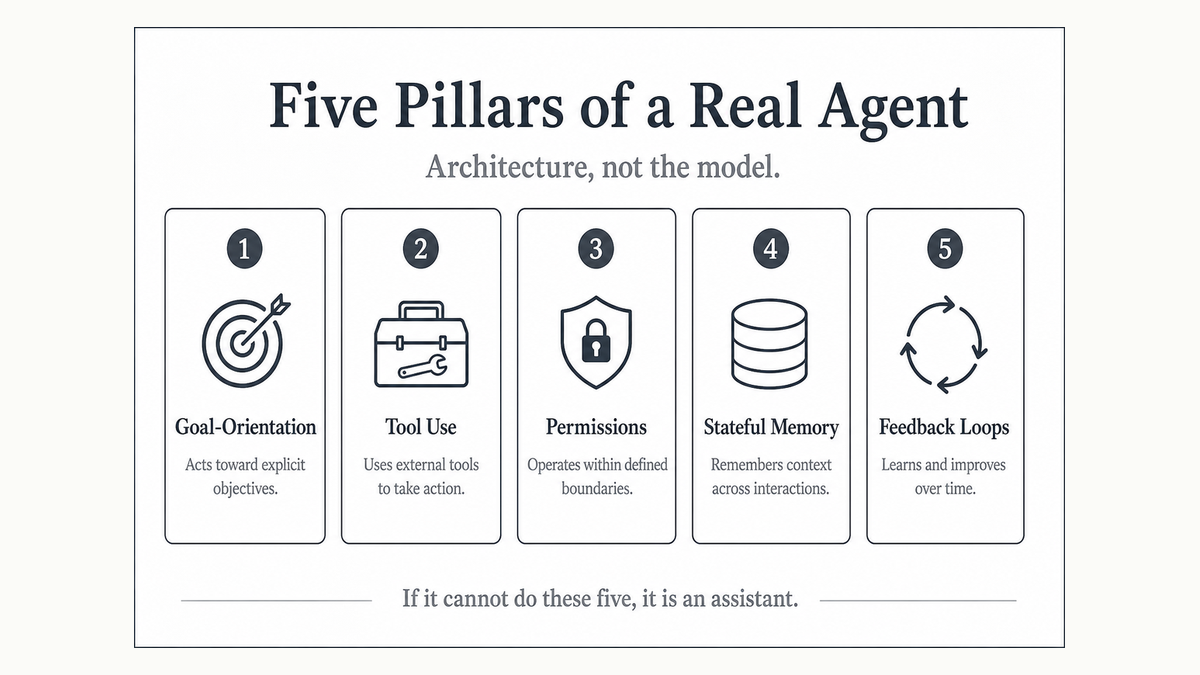
In my experience, a real AI agent is defined by system architecture, not by which model sits in the middle. A real agent needs five pillars.
1. Goal-orientation. It does not only answer a prompt. It pursues an objective across multiple steps until a stopping condition is met.
2. Tool use. It can do things: call APIs, query databases, edit files, not merely describe doing them in confident prose.
3. Permissions and boundaries. It has a defined sandbox. It knows what it is allowed to touch, and what it is not. Without this, “autonomy” is just an unbound credential with a language model attached.
4. Stateful memory. It remembers what happened in step 1 while it is performing step 10. If every turn is amnesia with a longer context window, you have a conversation, not a process.
5. Feedback loops. It can observe its own output, spot an error, and try a different path without you telling it to. That is the difference between a single shot and a loop that owns progress.
If it cannot do these five things, it is not an agent. It is a sophisticated assistant. Assistants are useful. Pretending they are agents is what creates the babysitting tax.
Anthropic’s Building Effective Agents draws the line cleanly: workflows orchestrate LLMs through predefined code paths; agents are systems where the model dynamically directs its own process and tool use. Their advice is even more uncomfortable for the launch-culture crowd: start simple, and only increase autonomy when you need it. Most products should be honest workflows. Few deserve the agent loop.
The babysitting test
Here is a field test that cuts through the costume.
Hand the system a real objective with tools attached. Walk away for ten minutes. When you come back, ask three questions:
- Did it progress toward the goal without another prompt from you?
- Can you see which tools it called, why, and what came back?
- When it failed, did it recover, escalate, or stop inside a boundary, or did it invent a finished answer and wait for applause?
If you still have to rewrite every paragraph, approve every step, and re-prompt every failure, you do not have an agent. You have a chatbot that makes you feel behind for not calling it one.
Agentwashed tools are expensive because they add a second job: supervising a system that was sold as unsupervised.
Map the workflow before you buy the label
The winners of the next eighteen months will not be the teams with the most “agents” on a slide. They will be the teams who understand their workflows well enough to know where a real agent actually fits, and where a fixed workflow or a plain assistant is the correct, cheaper, more auditable choice.
Stop chasing the label. Start mapping the system.
Ask, for each step: who decides what happens next? What tools are in reach? What is forbidden? What state must survive across steps? What counts as failure, and who notices?
If you cannot answer those questions, you are not ready for an agent. You are ready for a clearer process. An agent will not invent that process for you. It will amplify whatever confusion you already have, faster.
The question worth asking
Are you seeing real agents in the wild, or just assistants in agent costumes?
If everything on your feed still needs a human babysitter for every output, believe the behavior, not the brand name.
References
- Anthropic, Building Effective Agents
- PYMNTS, How to Recognize Agent Washing Before AI Leaves You out to Dry (reporting Gartner on agent washing and the ~130 real-vendor count)
- Forbes / Bernard Marr, What Is AI Agent Washing And Why Is It A Risk To Businesses?
- InformationWeek, How CIOs can tell real AI agents from agent washing
- Earlier on this site: What Makes an AI System an Agent, and What Does Not