AI Should Enhance the System, Not Subsidize Unclear Thinking
A powerful model cannot fix unclear thinking. It can make it faster and more confident. The advantage is directing the workflow: the job, context, constraints, checks, and where it can fail.
A powerful AI model cannot fix unclear thinking.
It can make unclear thinking faster, more polished, and more confident. That is not a small problem. Confidence without clarity is how bad decisions get dressed up as finished work.
The model matters. The tools matter. The orchestration matters. But before all of that, the user needs to understand the workflow.
I have written before that a better model will not fix unclear thinking. This post is the systems version of that claim: substitute versus augment, and why access to AI stopped being the advantage.
Two ways to use AI (only one compounds)
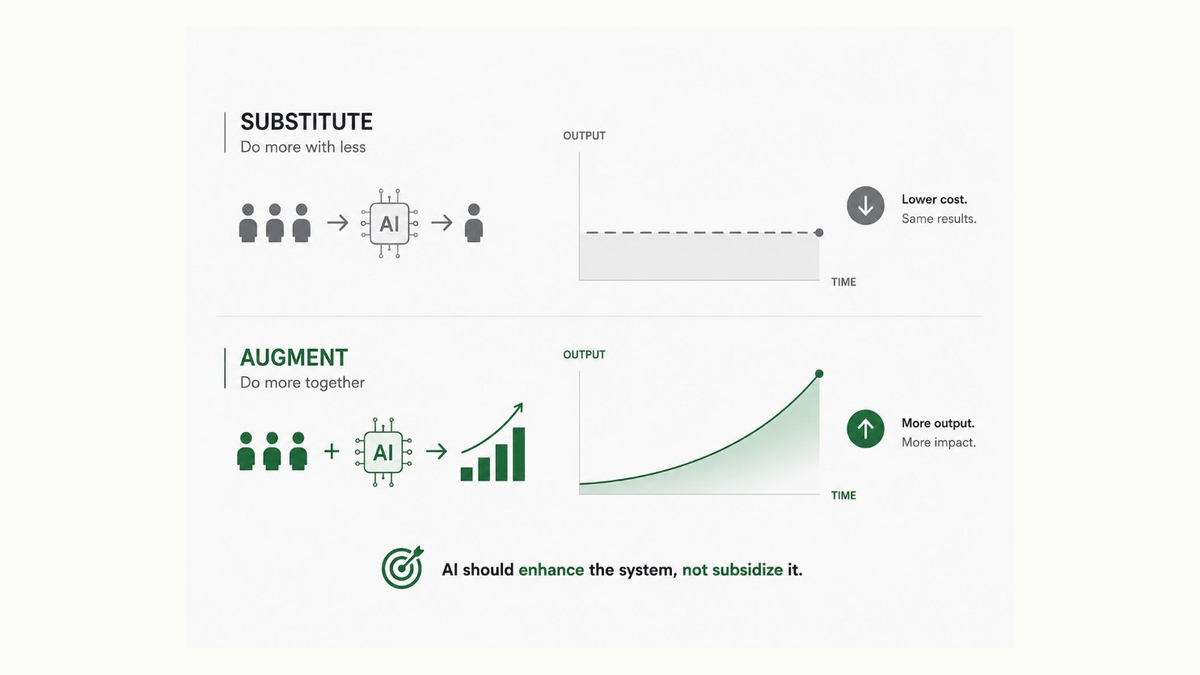
Substitute is the “do more with less” path. Replace people or steps with a model, keep the same process shape, and hope the output holds. You often get lower cost and the same ceiling. The dashed line stays flat.
Augment is the “do more together” path. Keep human judgment in the loop where it belongs, and redesign the work so AI raises throughput and quality. Output can compound because the system changed, not because a chatbot answered faster.
The line under the figure above is the whole argument: AI should enhance the system, not subsidize it.
If you use a frontier model to prop up a messy brief, a missing checklist, or a decision you still cannot state in one sentence, you are subsidizing confusion. The output will look better. The thinking will not.
The data agrees with the boring version of this
McKinsey’s State of AI survey work puts workflow redesign at the center of value capture. Across the organizational attributes they tested, redesigning workflows had the biggest effect on an organization’s ability to see EBIT impact from gen AI. Only about 21% of respondents whose organizations use gen AI said they had fundamentally redesigned at least some workflows.
Read that carefully. Most organizations are adopting the tools. Fewer are changing the work. The financial signal shows up where the work changes.
McKinsey’s broader research on people, agents, and robots makes the same split: applying AI to discrete tasks inside a legacy process is not the same as redesigning the process so people and AI create more value together. Task automation can look busy. Workflow redesign is what moves the curve.
Their agentic guidance is even blunter: when agents are embedded into a legacy process without redesign, they typically become faster assistants inside a still-sequential system. The process stays the bottleneck. That is substitution with better branding.
Abdication is not augmentation
A Harvard Business School and MIT field study of 244 BCG consultants working with GPT-4 found three modes of human–GenAI co-creation (HBS working paper):
- Centaurs (directed): humans decide what needs doing and steer the split of labor. They tended to upskill in domain work.
- Cyborgs (fused): dense back-and-forth with the model. They tended to build new AI-related skill.
- Self-Automators (abdicated): hand the whole problem over. They did not grow domain expertise or AI expertise.
The paper’s two questions are the ones most prompt libraries skip: who selects what needs to be done, and who identifies how it gets done?
Self-automation feels like leverage. In that study, it was the path that bought neither better judgment nor better AI skill. That is substitute thinking at the individual level: outsource the hard part, keep the costume of productivity.
Before the model runs, settle five things
This is why AI is not just about prompting.
The best users do not treat AI like a magic output machine. They treat it like a system that needs direction, structure, and feedback.
Before you open the chat box, answer these:
- What is the actual job? One sentence you could say out loud.
- What context does the system need that it cannot invent responsibly?
- What constraints should guide it? The “must not” list is usually longer than the “must.”
- How will the output be checked, and by whom?
- Where can it fail, and what happens then?
Skip those five and you will argue about models, because shopping is easier than thinking. Keep those five and most serious models will do a reasonable job, because you finally gave them a job.
Access is not the advantage anymore
Access to AI is not scarce. Direction is.
AI will reward people who understand workflows, systems, constraints, and decision-making. Not people who only collect prompts. A prompt is a photograph of somebody else’s thinking about somebody else’s problem. It carries none of the judgment that produced it.
The uncomfortable implication is personal. If your results with AI are mediocre, the first place to look is not the vendor leaderboard. It is whether you can describe the work clearly enough that a junior colleague, or a model, could execute against it without guessing.
Enhance the system. Do not subsidize the fog.
References
- McKinsey QuantumBlack, The State of AI (workflow redesign and EBIT impact; ~21% redesigned workflows)
- McKinsey Global Institute, Agents, robots, and us
- McKinsey QuantumBlack, Seizing the agentic AI advantage
- Dell’Acqua, Mollick, et al., Cyborgs, Centaurs and Self-Automators (HBS / MIT; BCG field study, n=244)
- Earlier on this site: A Better Model Will Not Fix Unclear Thinking