The Expertise Paradox: AI Is Eating the Junior-to-Senior Career Ladder
The real AI threat is not mass job loss alone. It is the collapse of the training ground. Automate the easy work and you may erase how hard expertise gets built.
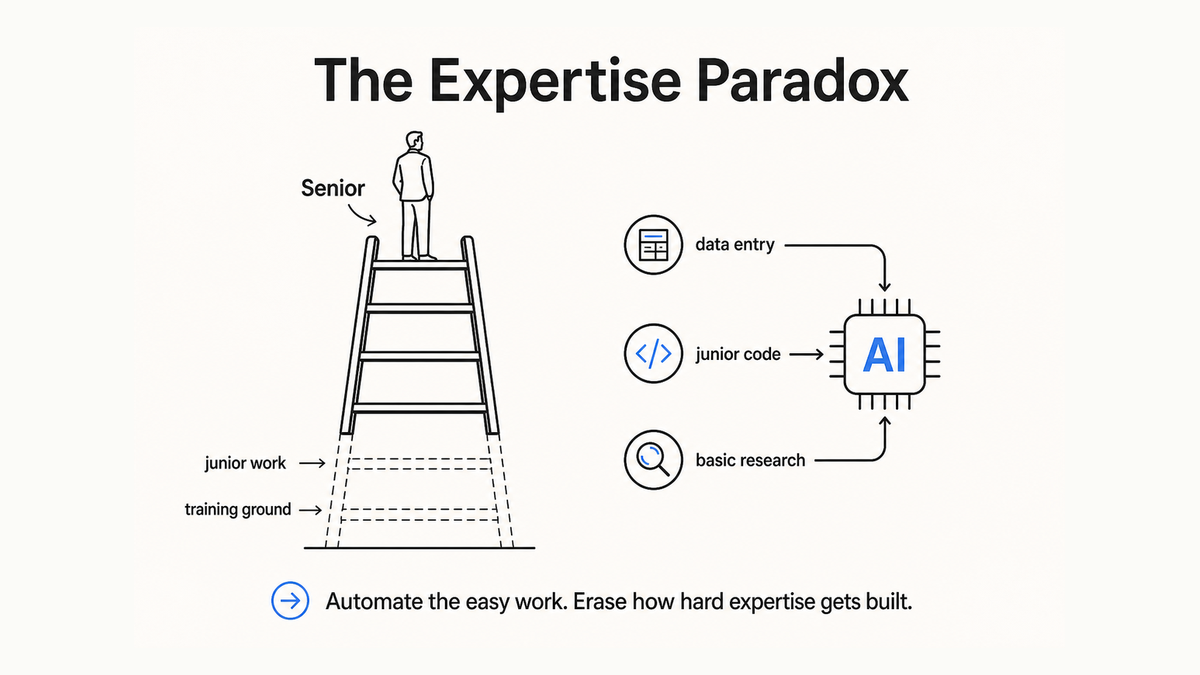
The real AI threat is not only job loss.
It is the collapse of the junior-to-senior career ladder.
AI is eating entry-level work first: data entry, customer support, junior code, basic legal research. Those were not only “low-skill jobs.” They were how people learned. They were the training ground.
Now that pipeline is thinning. We are building a workforce of seniors with fewer people coming up behind them, and a generation of juniors with fewer places to earn their stripes.
That is the Expertise Paradox: we automate the “easy” work to gain efficiency, but the easy work is how hard expertise gets built.
The ladder is the point, not a side effect
In many white-collar careers, the first years are intellectually mundane on purpose. You debug. You review documents. You clean data. You draft the boring first pass. Those tasks are repetitive, and they are also how judgment forms: error correction, pattern recognition, and the slow sense of when something looks wrong.
Harvard researchers Seyed M. Hosseini and Guy Lichtinger call the current pattern seniority-biased technological change. In high-skill roles, juniors traditionally start with routine cognitive work (debugging, document review) and climb into complex problem-solving and management. If generative AI substitutes for those entry tasks, the lower rungs of the ladder erode even when senior demand holds.
Their firm-level evidence matches that story: after generative AI adoption, junior employment fell relative to non-adopting firms, while senior employment did not show a comparable break. The drop concentrates in junior roles with high GenAI exposure, not across every junior job equally.
That is not “AI ends work.” It is “AI deletes the apprenticeship layer.”
The data is already pointing at early-career exposure
The IMF’s 2026 staff discussion note on skills and new jobs points to the same early-career exposure pattern in the United States and cites emerging evidence that generative AI adoption weighs hardest on entry-level hiring where tasks are automatable rather than complementary. The Fund’s companion blog is blunt: entry-level jobs have higher AI exposure, and that is a challenge for people just starting (New Skills and AI Are Reshaping the Future of Work).
Stanford’s Digital Economy Lab work by Erik Brynjolfsson, Bharat Chandar, and Ruyu Chen (Canaries in the Coal Mine) is the payroll-data backbone behind much of that discussion. Their facts are careful: they do not find economy-wide job destruction. They do find young workers (ages 22–25) in highly AI-exposed occupations falling behind less-exposed peers, with no comparable gap for experienced workers; the adjustment shows up mainly as reduced hiring; and declines concentrate where AI substitutes for tasks rather than complements them. Their later ADP updates report that relative shortfall widening further through mid-2026 (August 2026 revision note).
The World Economic Forum frames entry-level work as where AI’s hiring and task change shows up first, and treats early-career pathways as something organizations must deliberately redesign, not something that rebuilds itself.
Read those findings carefully. Aggregate “jobs will be fine” averages can hide a structural hole at the bottom of the profession.
The Expertise Paradox has a name for a reason
In Issues in Science and Technology, Christopher S. Cotton and Lydia Scholle-Cotton define the AI expertise paradox clearly: the early-career professionals whose output benefits most from AI today may be the least prepared to lead tomorrow. The tools that let novices perform more like experts can also make them less likely to become experts, because high output can be decoupled from the productive struggle that builds mastery.
Brookings makes the long-horizon version of the same claim: much of today’s AI productivity boom is “borrowed expertise.” Seniors extract value from models because they already paid the developmental cost of knowing what to ask, what good looks like, and where a fluent answer is wrong. Collapse entry-level hiring and you dismantle the mechanism that produces the next seniors inside the firm.
I have been arguing adjacent points on this site: a better model will not fix unclear thinking, AI should enhance the system, not subsidize it, and workflow before the AI engine. The ladder problem is the workforce version of those claims. If you remove the practice layer, you do not only lose headcount. You lose the humans who can tell when the agent is confidently wrong.
In three years, the vacuum looks like this
Companies will have AI agents doing more of the volume work.
They will still need humans who understand why the output is wrong, incomplete, or unsafe.
Those humans used to be trained by doing the volume work.
If that training ground is gone and nothing replaces it (no deliberate practice, no supervised struggle, no redesigned junior roles), you get a structural vacuum: agents at the bottom, seniors at the top, and a missing middle that used to turn one into the other.
Communications of the ACM puts the educational question cleanly: the deeper consequence may be expertise formation, not only employment. The junior crisis is a professional-formation problem.
Who wins
The winners will not be the teams that use AI the most.
They will be the teams that still know how to think without it, and that redesign junior work so people still learn: verification, judgment, escalation, and ownership of outcomes.
Efficiency that eats the apprenticeship is not a free lunch. It is a deferred invoice for expertise.
What’s your take: are you rebuilding the ladder, or only automating the bottom rung?
References
- Hosseini, S. M., and Lichtinger, G. Generative AI as Seniority-Biased Technological Change (SSRN).
- International Monetary Fund. Bridging Skill Gaps for the Future: New Jobs Creation in the AI Age (SDN/2026/001); see also New Skills and AI Are Reshaping the Future of Work.
- Brynjolfsson, E., Chandar, B., and Chen, R. Canaries in the Coal Mine? Six Facts about the Recent Employment Effects of Artificial Intelligence (Stanford Digital Economy Lab); August 2026 revision highlights.
- World Economic Forum. Artificial Intelligence and the Future of Entry-Level Work.
- Cotton, C. S., and Scholle-Cotton, L. The AI Expertise Paradox (Issues in Science and Technology).
- Brookings. Borrowed expertise: Why AI’s productivity boom may not survive the generation that built it.
- Communications of the ACM. Expertise Formation as the Deeper Consequence of the GenAI Revolution.