AI Agents Need Exploration Mode and Execution Mode
Reliable AI execution depends on stable boundaries. Useful AI research depends on permission to challenge assumptions. Treating both jobs as one mode produces either rigidity or unnecessary risk.
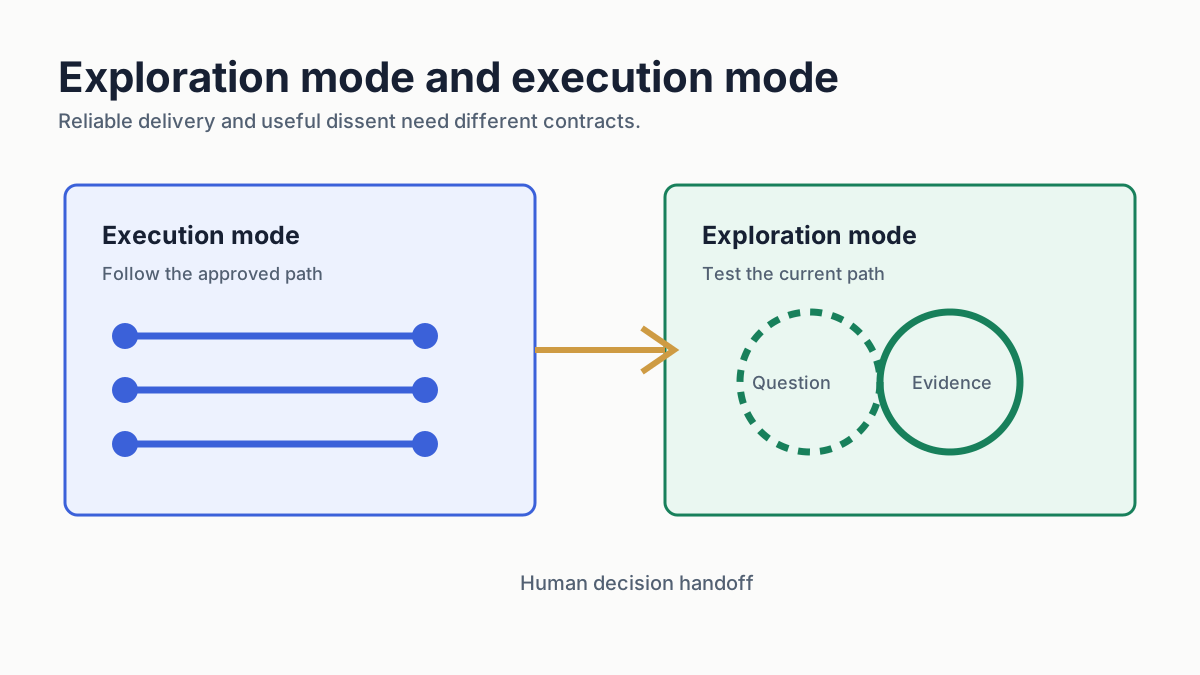
One instruction environment cannot do two opposing jobs equally well.
Execution needs the agent to follow established boundaries, use approved tools, preserve known interfaces, and stop when the work is complete. Exploration needs the agent to ask whether those boundaries, tools, and interfaces still make sense.
Mix those modes together and the system gets confused. Tell a research agent that the current architecture is mandatory, and its “research” will mostly become validation. Tell a production agent that it should freely question every decision, and routine work becomes unpredictable.
The answer is not more prompting. It is a deliberate distinction between exploration mode and execution mode.
Execution mode earns trust through consistency
Execution mode is appropriate when the task is understood and the cost of deviation is meaningful. The agent should have a defined objective, bounded tools, known escalation paths, and clear approval requirements.
This is where agent context should be firm. Follow the current data contract. Use the approved source. Do not access records outside the task. Request approval before an irreversible action.
These are not limitations on intelligence. They are the conditions that make an agent safe to use in a real process. Guardian agents argues that autonomy without a control layer is simply faster risk. Execution mode is where that control layer has to be most visible.
Exploration mode earns value through dissent
Exploration mode has a different contract. It should identify untested assumptions, compare alternatives, find evidence against the incumbent design, and make uncertainty explicit.
It does not get permission to rewrite production or relax safety boundaries. It gets permission to ask better questions:
- What problem does the current architecture solve?
- Which assumption is doing the most work?
- What has changed since the decision was made?
- What evidence would support a simpler approach?
- Where is the existing system producing recurring exceptions?
The output of exploration is not a code change. It is a recommendation with evidence, tradeoffs, confidence, and a named owner for the decision.
Exploration should also be evaluated differently. An execution agent is judged on reliability, policy compliance, cost, time, and whether it completed the defined task. An exploration agent should be judged on the quality of its alternatives, the evidence it found against the incumbent, the clarity of its uncertainty, and whether its recommendation helps a human make a better decision.
If both modes are judged only on speed or output volume, exploration will quickly become shallow. The agent learns that confirming the existing plan is safer than surfacing a difficult question. The purpose of exploration is not to create more motion. It is to improve the quality of the next commitment.
Anthropic's guidance to start with simple patterns before adding autonomous complexity belongs here. It is not an argument against agents. It is an invitation to test whether autonomy, multi-agent orchestration, or another layer of abstraction is actually justified by the work.
Do not call validation research
An organisation often asks an agent to “research the best architecture,” then gives it an instruction file that says the architecture is already settled. That is not neutral investigation. The existing design has been made the conclusion.
The same thing happens when a product team asks a model to assess whether a project should continue but only supplies success metrics. A credible review also needs the failure conditions, opportunity costs, and alternatives.
NIST’s AI RMF is useful as a discipline here. Its map function asks teams to establish context and understand risks, while its measure and manage functions require those assumptions to be assessed and acted upon over time. Governance is not a document written before deployment. It is a continuous function across the lifecycle.
One handoff between the modes
The important interface is the handoff:
- Execution reveals a pattern: repeated exceptions, rising cost, missed answers, or blocked work.
- Exploration investigates whether the rule, architecture, or source of truth should change.
- A human decision owner evaluates the recommendation.
- The accepted decision becomes updated execution context.
That loop makes the system learn without allowing a production agent to redesign itself during a customer task.
In a mature team, this handoff can become a simple operating rhythm. Execution logs the important exceptions. Once a week or once a release cycle, a small review looks for patterns rather than individual complaints. Exploration turns the highest-value patterns into short decision memos. A named owner either accepts the change, rejects it with a reason, or records what evidence is still missing.
That rhythm is deliberately boring. It should be. The point is not to make every system self-modifying. The point is to stop learning from being accidental, delayed, or dependent on whoever happens to notice the problem first.
The invisible box is what happens when this handoff does not exist. The agent sees the existing structure as reality and has no sanctioned way to show that it is no longer serving the goal.
The goal is disciplined uncertainty
An agentic system should be decisive where it must be decisive and curious where it can safely be curious. That is not indecision. It is a division of labour between operating a system and improving it.
References
- Anthropic, Building effective AI agents
- NIST, AI RMF Core
- Related on this site: Guardian Agents, The Invisible Box