Awareness Before Architecture: The Hidden Risk in Agentic Systems
Agentic systems can turn a vague idea into durable infrastructure before anyone has tested the assumptions. Awareness before architecture keeps fast execution from becoming fast commitment to the wrong system.
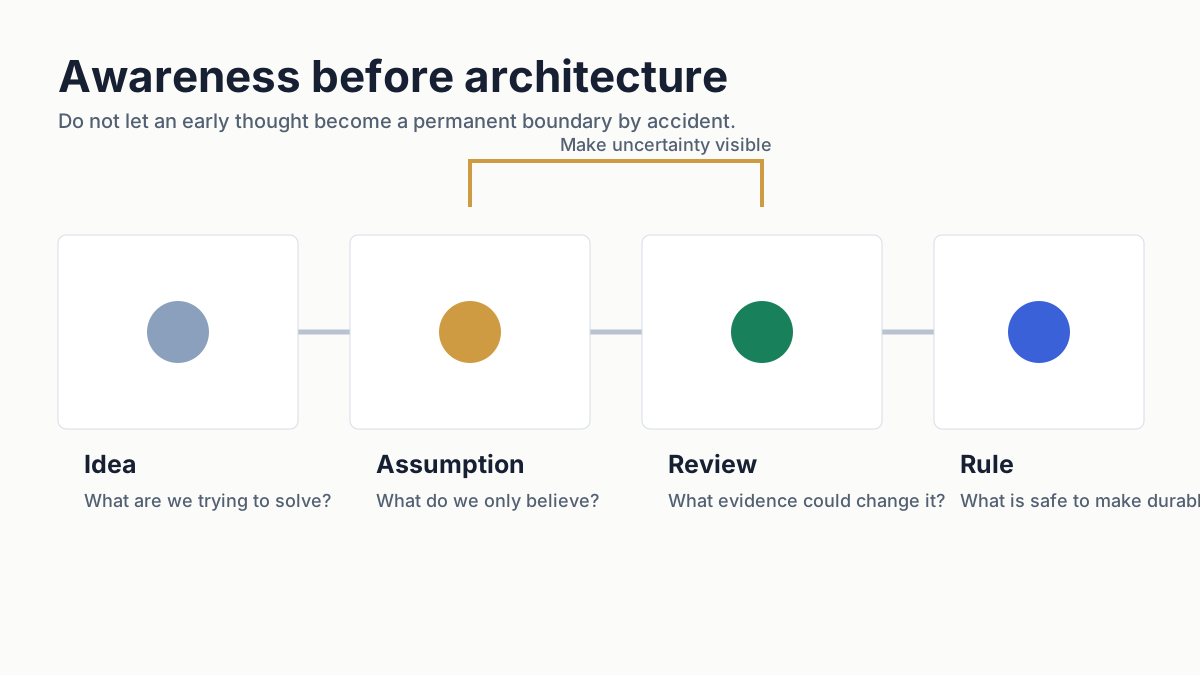
The first serious decision in an agentic system is not which model to use. It is deciding what you know, what you only suspect, and what the system is allowed to treat as settled.
That distinction matters because AI compresses the distance between an idea and an implementation. A rough thought can become a repository, a set of specialist prompts, tool permissions, workflow rules, and production-looking output before the person who started it has worked out the actual problem.
The result can look impressive. Files exist. Agents have names. The model completes tasks. Tests pass. None of that proves the system was built around the right assumptions.
I have argued before that a better model will not fix unclear thinking. Agentic systems make the same problem more consequential. Unclear thinking is no longer only a weak prompt. It can become architecture.
Speed changes the cost of being early
Traditional software gave teams friction. Requirements were debated because implementation took time. A wrong abstraction was expensive enough to notice.
An agentic build removes much of that friction. A builder can describe a half-formed idea, ask an AI to make a plan, then ask it to make the folders, code, rules, and interfaces. The system has moved from possibility to policy before the problem has been properly examined.
The failure is not that the model is unintelligent. Often the opposite is true. The model faithfully optimises within the decision space it receives. If the decision space is too narrow, a more capable model simply becomes better at pursuing the wrong system.
This is why the debate cannot stop at prompts or model quality. It must include the environment around the model: instructions, tools, permissions, memory, routing, evaluation, and the authority each piece of context is given.
Awareness is not certainty
Awareness does not mean pretending to know every feature before work begins. That would freeze useful exploration. It means being honest about the state of knowledge.
A team can know the objective but still be uncertain about the architecture. It can have a security boundary without knowing the best retrieval strategy. It can have a user need without knowing whether it needs one agent, several agents, or a deterministic workflow.
Those are healthy unknowns. The mistake is writing them as though they are permanent facts.
There is a useful test here. Imagine that a capable new engineer joins the project six months from now and asks, “Why is this rule here?” If the only answer is “because that is how we started,” it is not a stable architectural principle. It is a decision that has lost its context.
AI makes that loss of context easier to miss. The agent can turn an instruction into working code so quickly that the work itself feels like evidence. It is not. A functioning prototype proves that one path can be implemented. It does not prove that the path is the right way to solve the problem, that it will survive real data, or that its tradeoffs remain acceptable as the system grows.
The distinction is subtle but important. Demonstrability is not validation. A model that produces a beautiful first version can remove the friction that would otherwise force a human to think through the weak parts of the idea.
Anthropic's architecture guidance starts with the simplest workable system and distinguishes predictable workflows from agents that direct their own process. That is a useful discipline because it treats complexity as something to earn, not something to declare at the beginning. What makes an AI system an agent explains why that control-flow distinction matters in practice.
The new architectural question
Before making a rule persistent, ask four questions:
- Is this a non-negotiable boundary, a current decision, or a hypothesis?
- What evidence would show that it is wrong?
- Who owns revisiting it?
- When should it be revisited?
If there is no answer to the last three, the instruction is not mature architecture. It is a thought that has been promoted too early.
That does not make the instruction useless. It changes how it should be stored and presented to an agent. A hypothesis belongs in a reviewable decision log, not beside a safety constraint as though both carry equal authority.
A short pause before permanence
The practical habit is not a long planning ceremony. It is a short pause before making a choice persistent. Before an instruction becomes part of a repository, agent profile, routing rule, or tool policy, write a one-paragraph decision record:
- Decision: what is being chosen right now?
- Reason: what problem does it solve, and what tradeoff does it accept?
- Confidence: is this a constraint, a current preference, or a hypothesis?
- Review trigger: what event would make the team revisit it?
That record changes the conversation. “Use one research source” becomes “use one research source for the prototype, then revisit if unanswered questions or source conflicts cross an agreed threshold.” The implementation can still start today. It simply does not pretend to know more than the team knows.
This is also a better way to use an agent in the earliest stage. Ask it to map assumptions, alternatives, and missing evidence before asking it to produce folders and code. The first deliverable should often be an uncertainty map, not an architecture diagram.
What awareness looks like before the build
Awareness is practical. Before an agent begins implementation, the builder should be able to state the job in one sentence, name the user or operator who benefits, and describe the decision that will be better if the system works. If that sentence keeps changing, the project may still be in discovery. That is useful information, not a failure.
The next step is to name the boundaries. What may the system do? What must it never do? Which outputs are advisory, and which can trigger a real action? Where does it need a person because the cost of being wrong is too high? A project can have these answers without committing to its data store, tool stack, or agent topology.
Finally, name the assumptions that have not earned rule status. Perhaps users will accept a review step. Perhaps one agent can handle the work. Perhaps a public source covers enough of the required evidence. These are not embarrassing gaps to hide in a planning document. They are the experiments that make the next architectural choice more intelligent.
This order creates a healthier relationship with speed. You can use AI to produce prototypes, tests, diagrams, and alternatives quickly. You simply avoid confusing velocity with understanding. The system stays adaptable because its builders know which parts of it are still provisional.
Build the machine you understand
The answer is not to avoid structure. An agent without boundaries, measurement, or ownership is not more intelligent. It is simply less governable. Guardian agents makes the complementary point: when a system has power to act, oversight must be part of the design.
The answer is to make the maturity of the system visible. Keep hard limits hard. Keep open questions open. Give the model enough context to work well, but do not turn every early sentence into a law of nature.
Awareness before architecture is not a call to move slowly. It is a call to know the difference between moving fast and committing early.
References
- Anthropic, Building effective AI agents
- OpenAI, A practical guide to building agents
- Related on this site: A Better Model Will Not Fix Unclear Thinking, What Makes an AI System an Agent