When a Crypto Theft Is Bigger Than One Transaction
A crypto theft can involve many wallets set up before the main move. What on-chain data can prove, where the public record stops at an exchange, and why overstating the trail hurts the case.
This is based on real work. The amounts, dates, and details have been changed so nobody involved can be identified.
A large sum left a wallet in a single transaction earlier this year. The interesting part was never that transaction alone. It was the several wallets around it, and the fact that most of them had already done their jobs before the money moved.
That pattern matters. A theft like this is rarely one address acting alone. It is usually a short chain of wallets, each doing one narrow thing, arranged in advance. The public record can show that the movements fit together. It does not, by itself, name anyone.
What the chain can show
Follow the trail and you can often see whether wallets behaved as one operation or as unrelated noise. Timing, direction, and repetition can support that reading when they line up.
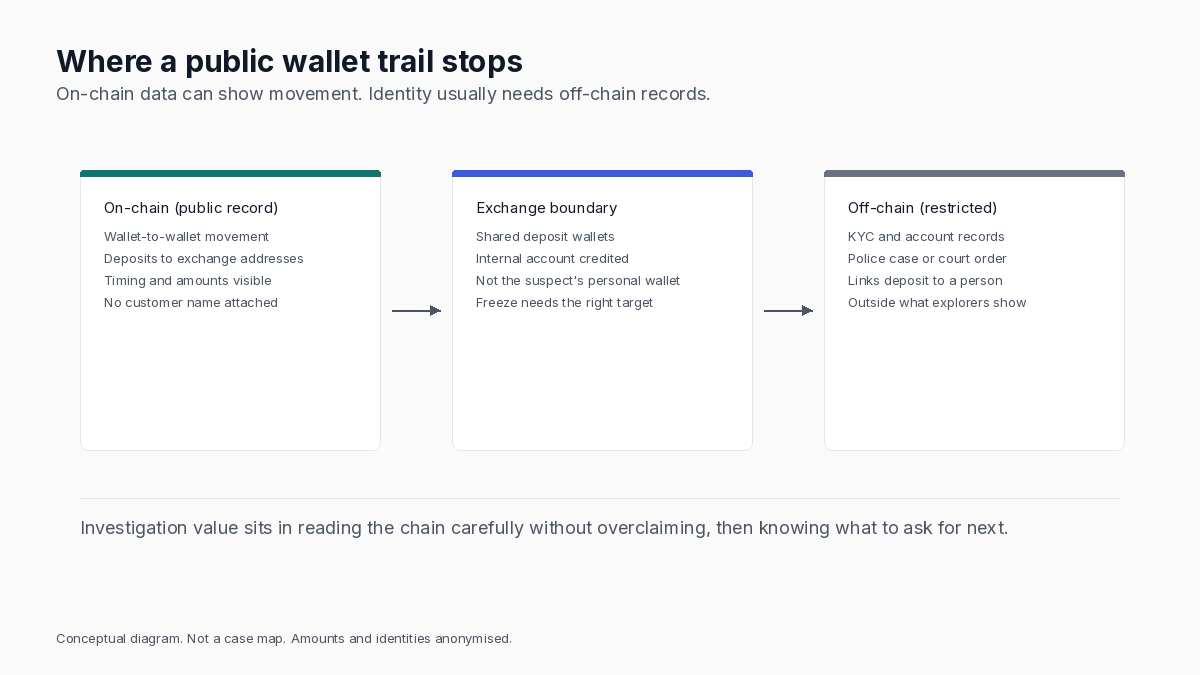
What the chain cannot do is turn a wallet into a person. An address is not an identity. Behaviour is not intent. Every step from movement to accusation needs its own evidence, and the gap between them is where weak cases fall apart.
One general point worth keeping in mind: a token approval is not a payment. It is permission. Unless a limit is set, it may have no cap and no expiry. It can apply to balance that arrives later, not only what is in the wallet at the moment someone signs. That is a common way people lose funds, and it is separate from whether a given theft was coordinated.
Where the trail stops
Follow the movements far enough and you usually arrive at an exchange deposit. That is the end of what explorers and public chain data give you.
Getting from a deposit to a name needs the exchange to release customer records. No exchange can do that without a law enforcement case number or a court order. The address money lands on at an exchange is often not a suspect's personal wallet at all. It is a shared wallet holding funds for many customers. What matters is the internal account credited by that deposit. Point a freeze request at the wrong target and it goes nowhere.
Earlier on-chain activity can also mislead if you read it out of order. Money that moved before a theft is not necessarily part of that theft. Treat unrelated timing as one story and you build a claim the evidence may not support.
What I take from it
Cases like this are mostly an exercise in not overclaiming. I can often say the wallets behaved as one operation. I cannot say who ran them from the chain alone. The useful work sits in reading the record carefully, knowing what to ask for next, and stopping where the evidence stops.
If money has gone missing and you need someone to find where it went, get in touch. If you want structured training on how this work is done, c4 Academy runs programmes for law enforcement agencies and investigators, or write to me directly.